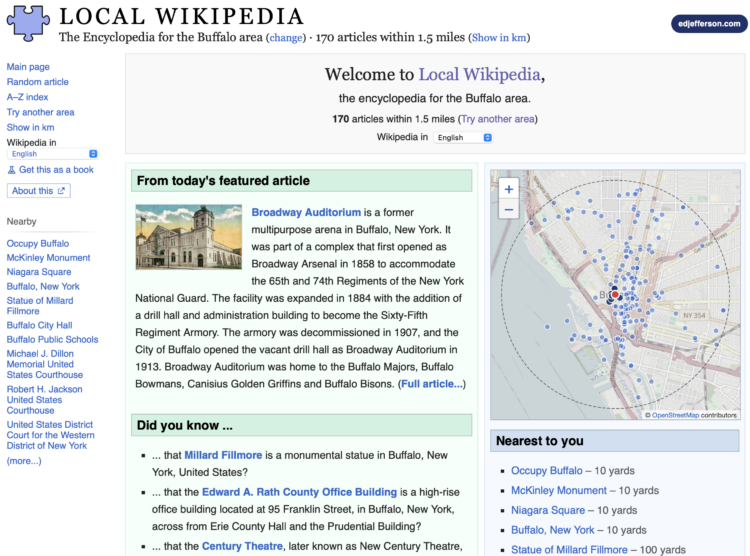
Local Wikipedia, by Ed Jefferson, subsets regular Wikipedia to people, places, and things that are within a half hour walk from you. Just enter a location and get the localness.
Local Wikipedia, by Ed Jefferson, subsets regular Wikipedia to people, places, and things that are within a half hour walk from you. Just enter a location and get the localness.
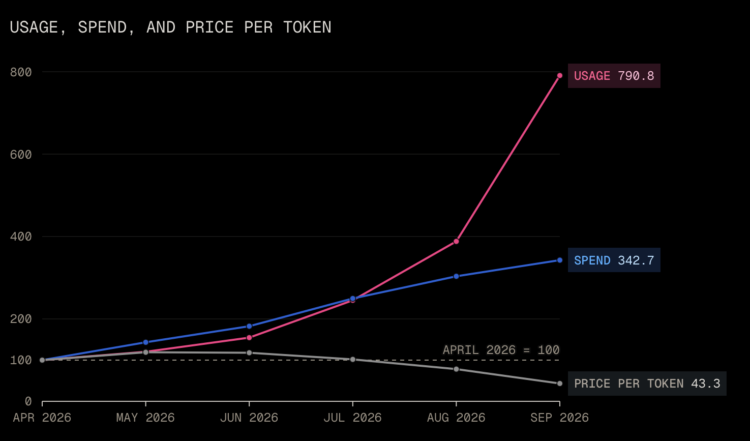
On a per token basis, the cost of using LLMs from Anthropic and OpenAI decreased a lot over just the past few months. Max Woolf lays out the fast timeline.
From the timeline above, there is a clear tit-for-tat between Anthropic and OpenAI, and it is reasonable to assume that these particular price cuts from OpenAI and Anthropic are in reaction to each other. However, no one cuts prices by 80% unless there is some externality in play. So, what gives?
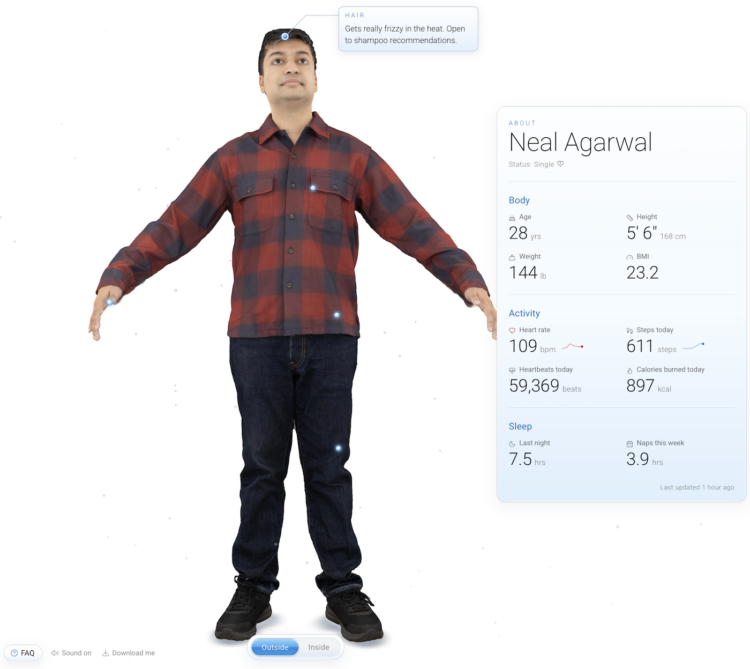
You know the about pages on every site that provide a summary of topics covered. Maybe there is a little bit about the writer. Neal Agarwal took the about page in a more literal direction. There is an interactive 3-D scan (that you can download) and live metrics from Agarwal’s fitness watch, so you know that he took 3.9 hours of naps this week and has type B+ blood.
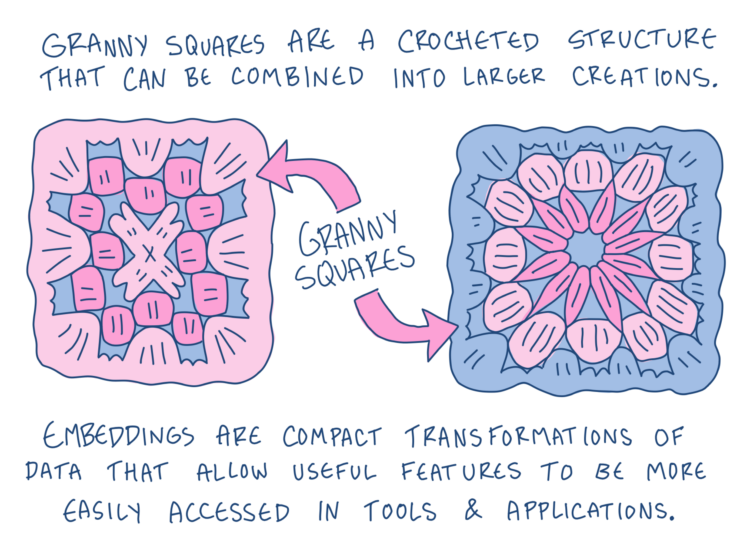
For Development Seed, Kiri Carini and Martha Morrissey explain what embeddings are and what they are used for.
An embedding represents this information as numbers grouped into dimensions of a “latent space.” We are used to describing our world with three spatial dimensions, but dimensions in latent space are mathematical rather than physical. Together, they encode patterns and relationships the model has learned from the data.
As humans living in a three-dimensional world, it’s hard to imagine a space with dozens, hundreds, or even thousands of dimensions. This makes embeddings difficult for humans to interpret directly, but computers have no problem working with these mathematical representations. In practice, an embedding is usually stored as a list of numbers.
Illustrations by Gus Becker provide a crochet metaphor to help you mentally link the steps. While in the context of geospatial data, the guide should also be helpful in understanding embeddings in general.
Terence Tao has become the unofficial spokesperson for the future of mathematics. Elisabeth Bumiller, for the New York Times, reports on the soured relationship between Tao and OpenAI:
OpenAI’s releases have now left him feeling used. “As recently as a year ago, I had a pretty good relationship with many employees at OpenAI,” he said in a recent phone conversation.
“A lot of people I interacted with shared a very common vision of how A.I. should be used — you know, to empower scientists.” But the rush to publish new findings, he said, shows their true purpose. They “used math for what they needed, which was to evaluate their models,” he said. “At this point, I don’t see a way to constructively engage.”
I feel for the PhD students who are four years into research and OpenAI comes along. I think the only successful path forward involves figuring out how these new tools intertwine with existing work.
Mathematician and Cornell professor Steven Strogatz was a guest on NYT’s Daily podcast to talk about the recent developments in Mathematics. Well, it starts out that way, and then Strogatz gets into purpose and touches on deeper feelings that many of us are getting to know.
If your electricity provider is an investor-owned company, it’s likely you’re paying more than someone with a public provider. For Bloomberg Green, Michelle Ma and Nadja Popovich highlight the difference:
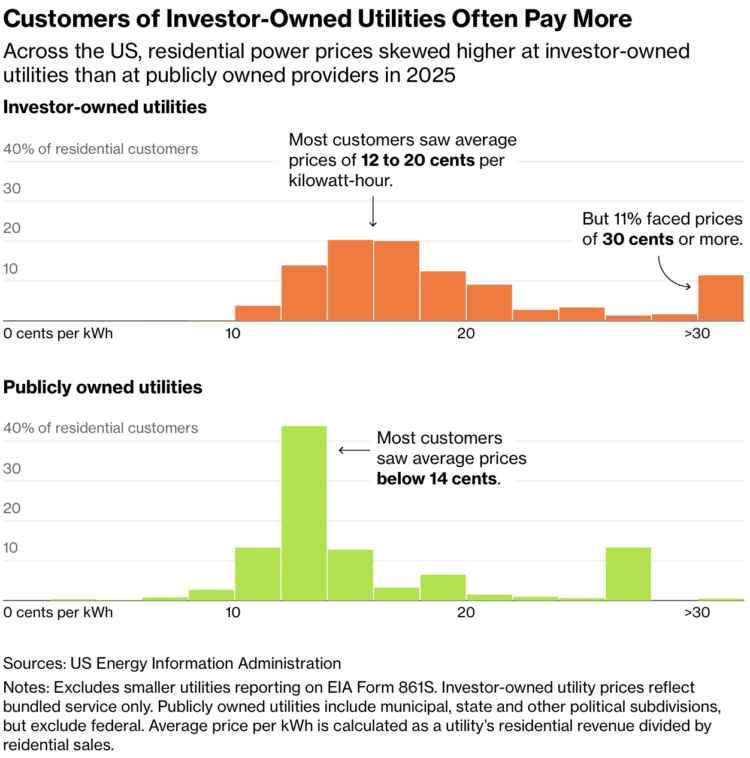
Estimates are based on data from the Annual Electric Power Industry Report published by the U.S. Energy Information Administration.
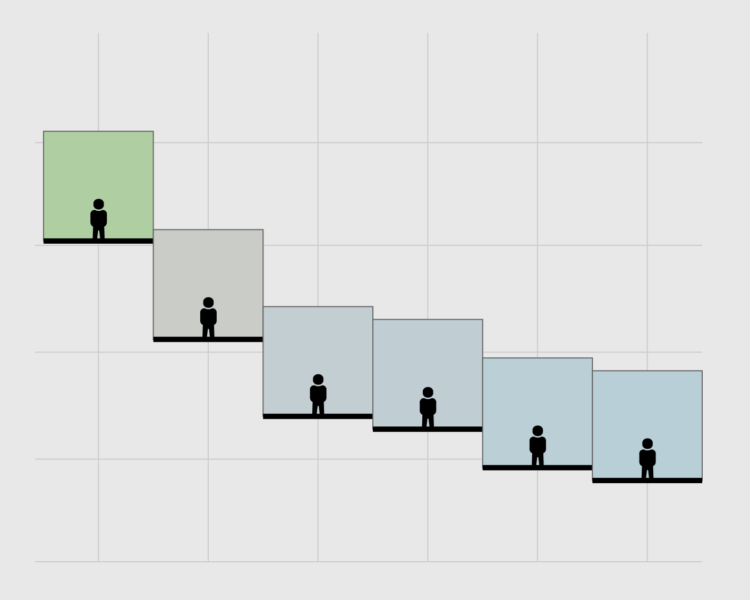
Results from the Survey of Consumer Finances were recently released, which means it is time for a rendition of seeing who has a higher net worth than you.
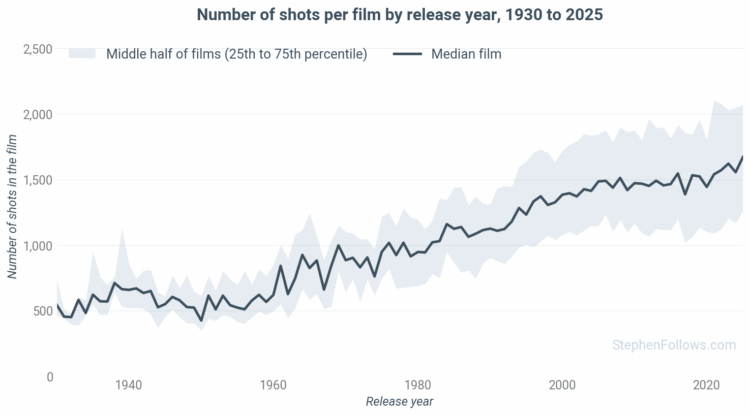
Stephen Follows counted the number of shots in movies, from 1920 through 2025. The overall number of shots increased, and so has the range.
Between the 1930s and 1950s, films averaged between 550 and 580 shots. The median started to climb in the 1960s and didn’t slow until the current century. In recent years, the increase has been minimal, sitting at 1,479 for the 2010s and currently 1,559 for the first half of the 2020s.
Follows used TransNet V2 for transition detection and shot count.
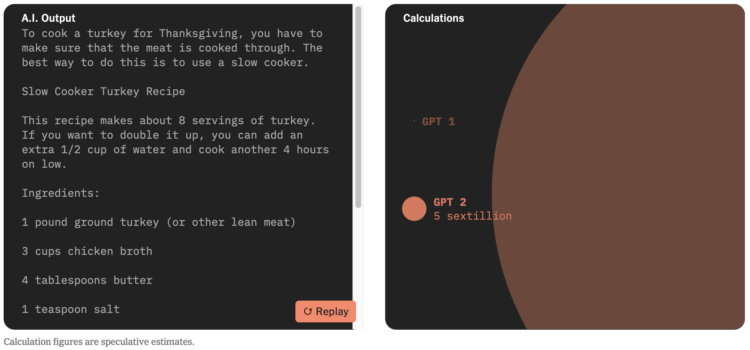
More big numbers coming in. For NYT’s the Upshot, Aatish Bhatia demonstrates the millions of trillions (octillions!) of calculations required for training AI.
During its training, the A.I. is fed a portion of a sentence, and the knobs are adjusted using a series of math calculations to improve its guesses for the next word. This process is then repeated over trillions of words of training data.
It takes only a few additions and multiplications to adjust a single knob. But when trillions of knobs are adjusted trillions of times, the math quickly adds up.
And this is just the first step in training a language model, known as pre-training. It’s followed by additional steps of calculations that hone the A.I.’s behavior and improve its ability to code and solve math problems.
All those calculations require energy, data, and time. The big companies are taking what they can get with the first two things in efforts to reduce the third.

This is fun, or I guess very serious depending on your point of view. Georgios Karamanis adapted the Show Your Stripes project, which visualizes average temperature each year as a stripe, into a screensaver that runs in macOS.
It is fascinating how a simple view of data can fit into different spaces.
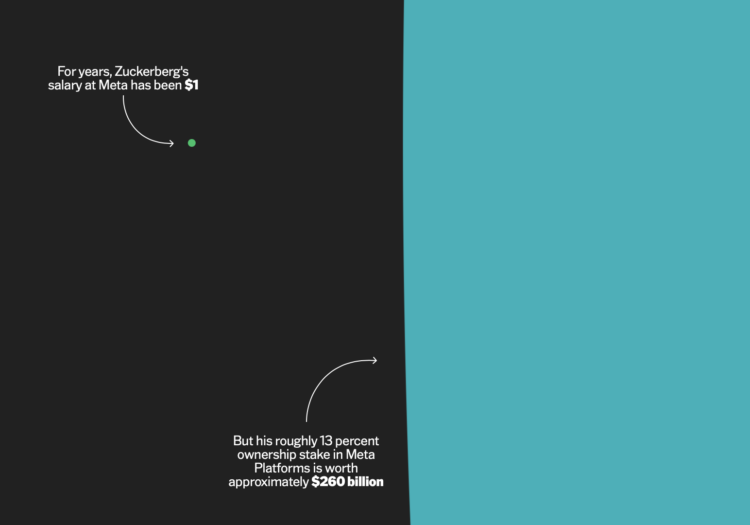
There is a proposition on the California ballot this year to impose a one-time tax for billionaires. The result would be a 5% tax on their net worth, which includes investments. For New York Times Magazine, Nicholas Konrad illustrates the scale of this tax on 250 individuals in the context of their wealth, the taxes they typically pay, and their spending to oppose.
For us regular people, one billion dollars is difficult to imagine, so the transitions between tiny and giant circles provide a sense of how big these numbers are. By absolute counts, the tax dollars are a lot, but by percentage, the tax rate doesn’t seem like that much all things considered.
This week, I walk through my own thinking as I poke at fresh data.
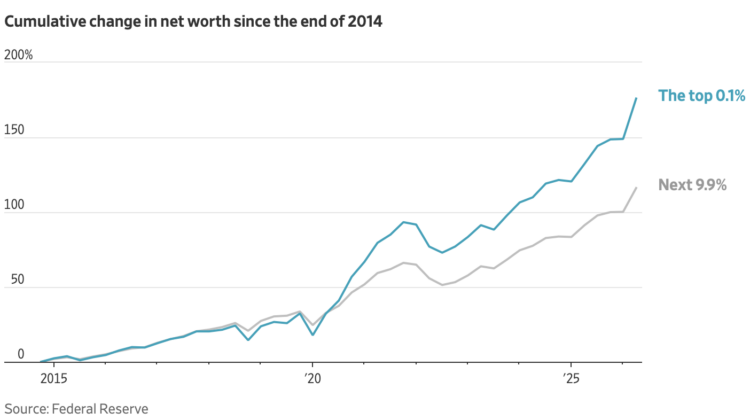
This is really going to surprise you, but the wealthy people in the United States became wealthier over the past three years. For the Wall Street Journal, Rachel Louise Ensign and Justin Lahart report on these changes with some charts.
The roughly 137,000 households who make up the nation’s top 0.1% had already become richer in comparison to everyone else in recent decades, thanks to higher incomes and lower tax rates. Now the stock-market boom, driven by strong corporate earnings and highflying tech stocks, is powering their wealth even further.
By comparison, the rest of the top 10% of richest Americans gained $38.2 trillion in wealth over the same period, but it was split among nearly a hundred times as many households.
This is based on fresh Federal Reserve data from the Survey of Consumer Finances.
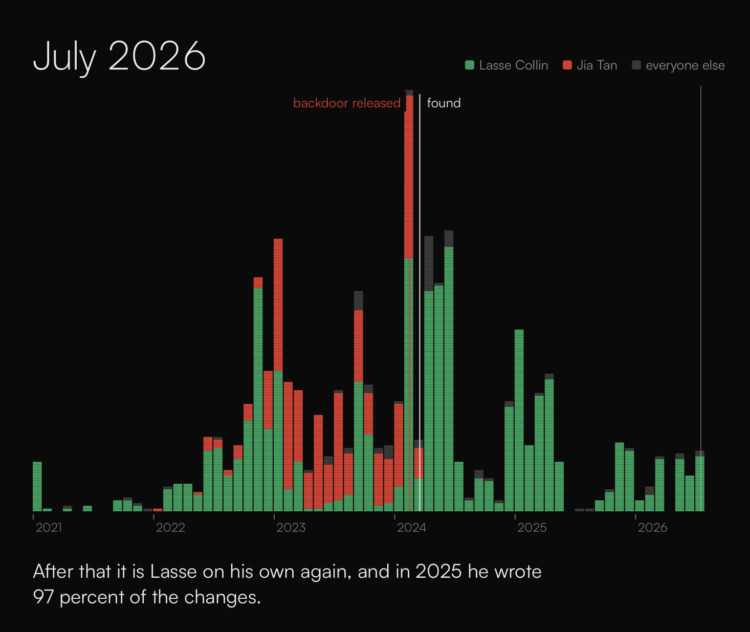
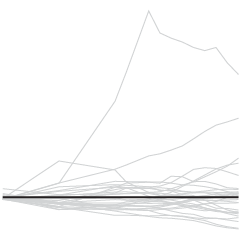
In reference to the xkcd comic that illustrates the internet as a stack of blocks propped up by a small project, sheets.works shows development history of real open source projects that our devices depend on. It is not uncommon for a single developer to maintain widely used open source software on a volunteer basis.
The Centre for the Study of the Legacies of British Slavery published a searchable database of four million records logged between 1813 and 1840. For the Guardian, Aamna Mohdin reports:
The registers were created by the British government after the abolition of the transatlantic slave trade in 1807, and were designed to prevent illegal trading of enslaved people and to monitor the enslaved population.
Researchers say people were recorded in the registers with chilling precision. Entries include names, ages, physical descriptions and family ties, as well as births, deaths and transfers of ownership. Some distinguish whether a person was born in Africa or in the Caribbean.
Nicka Sewell-Smith, a professional genealogist and senior story producer at Ancestry, said it was not lost on her that records originally created to count enslaved people as property were now being used by their descendants to reconstruct their family histories.
Daniel Willingham, a professor at the University of Virginia, argues that students should only use AI for things they know how to do well.
This lead/associate orientation makes sense for life after graduation. Once a student is in the workforce, they will use AI to produce products: new ideas, reports, and so on. A guiding principle of “Use AI, but let me see your work” makes sense.
This is not, however, an optimal guiding principle for students. Students produce products, but the product is seldom the point. No one wants to read the papers they write, and the math problems they solve have no practical value. Teachers have them do these tasks because they provide practice in cognitive abilities that we think matter.
I remember pulling all-nighters in the computer lab in college, with only Pop-Tarts and a fear of a failing grade to keep me going. What it must be like for students and educators these days knowing that the answer is only a prompt away.
I just keep telling my young kids (while they still listen to me) that we need to know how to do things and how things work. Things will break or need to get better, and that requires people who can think for themselves.
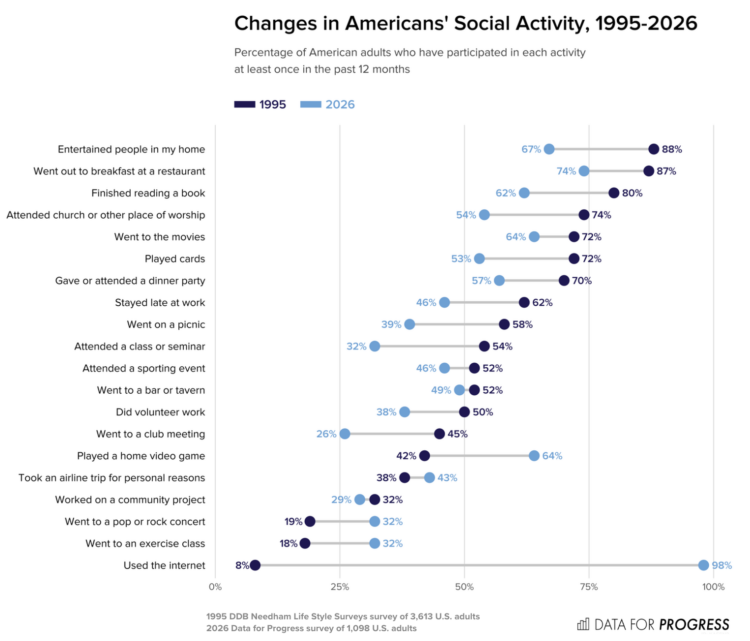
Data for Progress compared social activities among American adults in 1995 against 2026. Hanging out with others is down a lot for many activities.
We find that Americans’ participation in various social activities has declined by double-digit margins, including attending a class or seminar (-22), entertaining people in your home (-21), attending church or a place of worship (-20), going on a picnic (-19), going to a club meeting (-19), playing cards (-19), going out to breakfast at a restaurant (-13), and doing volunteer work (-12).
A few activities have seen increased engagement: using the internet (+90), playing a home video game (+22), attending an exercise class (+14), going to a pop or rock concert (+13), and taking an airline trip for personal reasons (+5).
At least staying late at work is also down quite a bit.
They used a dumbbell chart to show the difference, but arrows that start with the 1995 value and point to the 2026 value would make for an easier comparison. If they wanted to stick with the dumbbell, I would’ve switched the shades so that present day stands out more. The current color scheme reads backwards in time.
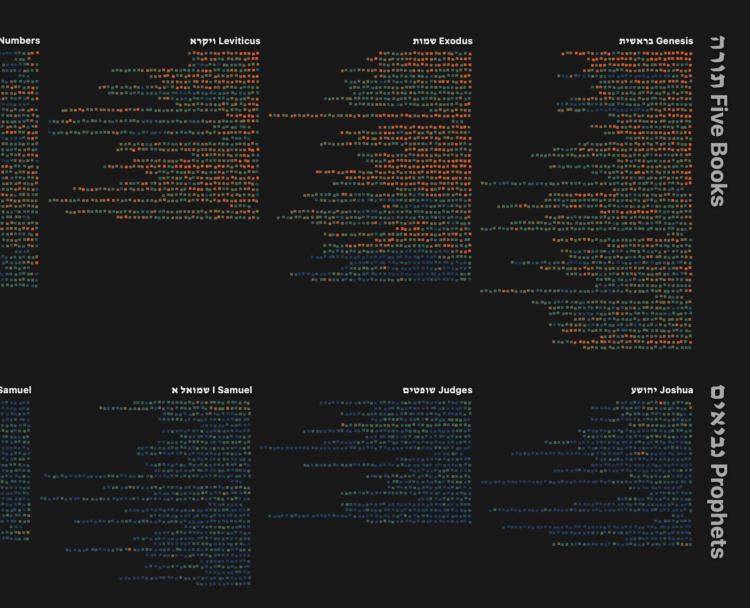
Torahmap by Danyel Fisher is an interactive visualization of the Hebrew Bible. Each column represents a book, each line represents a chapter, and each square represents a verse. Zoom and pan to see details.
I know little about the context, but I like the concept and interaction with text. People should do more with words as data.
 Visualize This: The FlowingData Guide to Design, Visualization, and Statistics (2nd Edition)
New tools, refined process.